
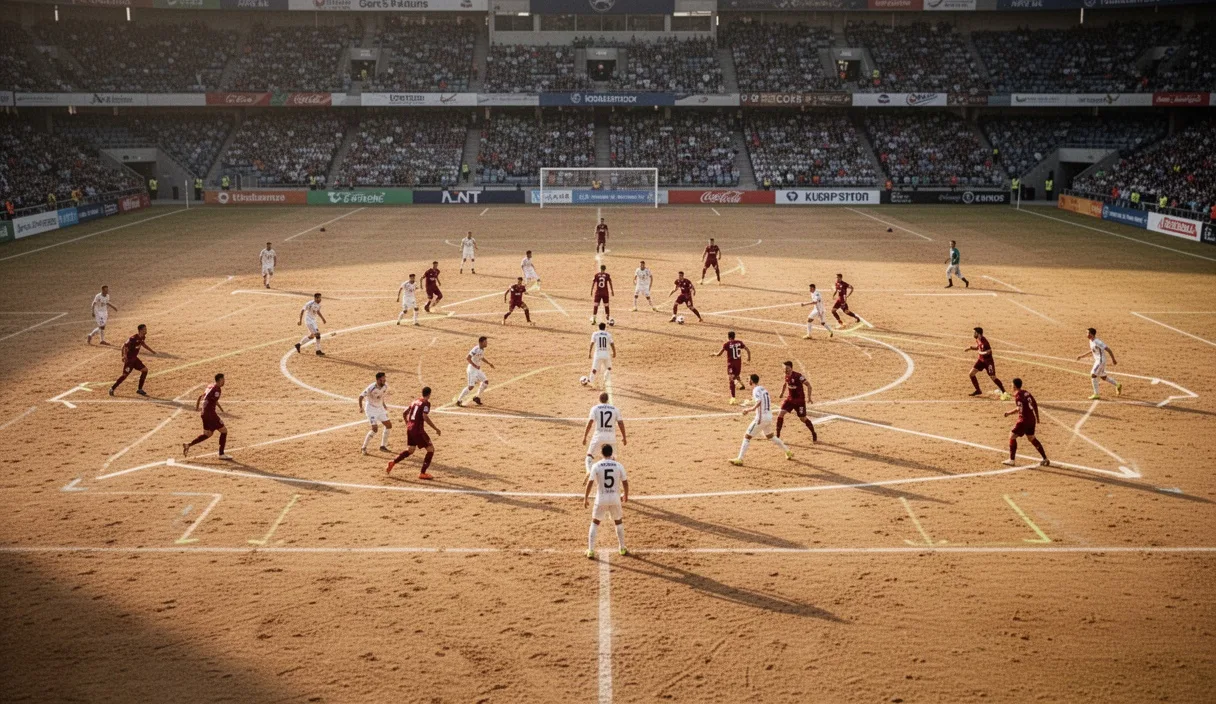

Watch any group of new fans at a bar during a match and you'll notice something: their eyes dart wherever the ball goes, like a cat chasing a laser pointer. It feels natural. The ball is the object of the game, so surely it deserves your attention. But ask a scout, a coach, or a longtime analyst where they look during a match, and most will tell you the same thing: they barely track the ball at all.
This isn't a trick or a superpower. It's a shift in what you're trying to understand. The ball tells you what already happened. The players without the ball tell you what's about to happen. Once you learn to split your attention that way, a match stops looking like twenty-two people chasing a ball and starts looking like a puzzle being solved and re-solved every few seconds.
Why the ball is the least useful thing to focus on
Think about reading a sentence one letter at a time versus reading the whole word at once. Watching only the ball is like reading letter by letter. You get information, but always a beat behind, and you miss the meaning of the whole sentence. The ball is just the most recent letter. It tells you where the action was a half-second ago, not where it's going.
Here's the physical reason this matters: a football pitch is roughly 105 by 68 meters, and at any moment only one of those small leather letters is moving with real purpose. Meanwhile, twenty other players are adjusting their position, and those adjustments are what determine whether the next pass is even possible. If you're staring at the ball, you see the pass after it's already been decided. If you're watching the space around the ball, you can often predict the pass before the player even looks up.
There's a reason coaches use the phrase "playing with your head up." A player who watches only the ball at their feet gets tunnel vision. Reading a match works the same way. If your eyes are locked on the ball, you develop a kind of viewer's tunnel vision, and the game shrinks down to a series of isolated moments instead of one continuous shape shifting across the field.
Where to look instead: the back line and midfield spacing
So if not the ball, then where? Start with the defensive line farthest from the ball, usually the back four or back three of whichever team doesn't have possession. Their positioning tells you almost everything about the tactical plan for that moment. Are they tucked in tight, 6 or 7 meters apart from each other? That's a compact defense trying to deny space through the middle. Are they stretched to 12 or 15 meters apart? They're likely inviting pressure wide and protecting the center.
The distance between lines matters just as much as the distance within a line. A useful mental measurement: if the gap between a team's back line and their midfield line is more than about 15 meters, the team is stretched vertically, and there's likely a pocket of space in there for an opposing attacker to receive a pass and turn. If that gap shrinks to 8 or 10 meters, the team has compressed itself into a defensive block, which is harder to break through passing but easier to break through movement.
Try this comparison: think of the team without the ball as a net curtain. When the curtain is stretched wide and loose, light (space) pours through the gaps. When it's gathered and compact, almost no light gets through, but the fabric itself is more likely to tear at a single weak point. Reading the "curtain" tells you where the game is likely to open up next.
| What you see | What it usually means |
|---|---|
| Back line spread 12+ meters apart | Space to play between defenders, riskier for the defending team |
| Back line tight, 6-8 meters apart | Compact block, harder to pass through, easier to overload out wide |
| Big gap between defense and midfield | Team is stretched vertically, pockets of space for attackers to exploit |
| Midfielders bunched near the ball | Team is trying to win the ball back quickly (pressing) |
A simple exercise to train this habit at home
You don't need special software or a coaching license to practice this. All you need is a match you can pause, and about 20 minutes.
- Pick a random moment, ideally when a team is building up play from the back, not during a fast counterattack. Pause the broadcast.
- Cover the ball with your finger on the screen, or simply refuse to let your eyes settle on it for 10 seconds.
- Scan the far side of the pitch first. Look at the two or three players farthest from the ball. Ask: are they making a run, holding a position, or drifting toward space?
- Predict the next pass out loud. Say where you think the ball will go based only on the shape you see, not the ball's current position.
- Press play and check yourself. You won't be right every time, maybe 4 or 5 out of 10 tries in the beginning. That's fine. The point is training your eyes to travel to the right part of the pitch before the ball does.
Do this for 15 to 20 repetitions in a session, a couple of times a week, and most people notice a real shift within three or four weeks. It's the same kind of skill-building as learning to read music instead of just following a friend's fingers on a piano; slow and mechanical at first, automatic later.
What off-ball runs tell you before a pass happens
Once you're comfortable scanning away from the ball, the next layer is understanding what different types of movement mean. Not all runs are created equal, and each one is basically a question the runner is asking the player on the ball.
- The run in behind (over the top of the defense): This is a direct question: "Can you play it over the line right now?" If a striker sprints past the last defender, they're not necessarily expecting the ball immediately; they might be testing the offside line or dragging a defender out of position for someone else.
- The checking run (toward the ball, then away): A midfielder jogs 5 meters toward the ball carrier, drawing a defender with them, then spins away into the space just vacated. This is designed to create separation, not to receive the ball on the first movement.
- The overlap (a fullback sprinting past a winger on the outside): This asks the winger to either cut inside or lay the ball off, because now there are two attackers occupying one defender's attention on that flank.
- The decoy run (a run made with no intention of receiving the pass): This is the hardest to spot because nothing seems to "happen." A player runs into a channel purely to pull a defender out of a zone so a teammate can exploit it. If you only watch the ball, decoy runs are invisible. If you watch the defenders reacting to the run, you can see the space being created in real time.
A good way to test your understanding: after a goal is scored, rewind 10 to 15 seconds and watch only the runner who didn't receive the final pass. In a large number of good team goals, there's a second or third player whose run created the space for the actual scorer, even though they never touched the ball.
How commentators talk about this without naming it
Commentators rarely say "watch the space behind the fullback" directly, but they hint at it constantly, and once you know what to listen for, their language becomes a second layer of instruction.
Phrases like "he's found himself in a pocket of space" or "there's nobody tracking that run" are direct references to off-ball positioning. When a commentator says a team is "camped in their own half" or "can't get out," they're describing the compactness of a defensive shape, the same spacing concept from earlier in this article, just translated into conversational language.
Listen also for tempo language: "they're patient here, probing," usually means the team on the ball is waiting for gaps to open in the defensive shape rather than forcing a pass into a crowded area. "They've caught them square" refers to a back line where every defender is level with each other, which is dangerous because a single well-timed run can beat the entire line at once, since no one defender is positioned slightly behind to cover.
Try muting a match for 10 minutes and predicting, based only on shape, what a commentator would likely be saying. Then unmute and check. This trains you to translate visual spacing into the same vocabulary broadcasters use, which makes future matches easier to follow even with commentary on.
Practicing this over a full 90 minutes
Reading a match this way for a full 90 minutes is tiring at first, the same way reading in a foreign language is tiring before it becomes automatic. A reasonable target for a beginner: pick one 15-minute stretch of the match, maybe the first 15 minutes after kickoff, and commit to watching primarily off-ball movement during that window only. Let your eyes follow the ball normally for the rest of the match.
As this gets easier, extend the practice window: 15 minutes becomes 30, then a full half. Some viewers find it useful to focus on one team's off-ball shape for an entire half, then switch to the other team for the second half, since trying to track both teams' spacing simultaneously from the start is a lot to process.
A practical marker of progress: if you can correctly anticipate roughly half of the next 10 passes in a build-up sequence before they happen, based on spacing rather than the ball's location, you're reading the game at a level most casual viewers never reach.
Common mistakes
The most frequent error is trying to watch everything at once. Twenty-two players is too much information for any one glance; pick a side of the pitch, a specific line, or a single player's runs for a few minutes at a time rather than attempting a panoramic view constantly.
Another common mistake is confusing stillness with inactivity. A defender standing still might be doing the most important job on the pitch: holding a defensive line to prevent an offside trap from breaking, or occupying a passing lane simply by being present in it.
Finally, many viewers give up too quickly because early predictions are often wrong. Being wrong is part of the process, not a sign you're doing it incorrectly.
Where to go from here
Start small: one match, one 15-minute window, one finger covering the ball on your screen. Build the habit before expanding it. Rewatch goals in slow motion and specifically study the player who made the final pass possible through movement, not the scorer. Over a season, this single shift in attention, from the ball to the space around it, tends to change how enjoyable and readable football becomes, even if you never coach a single player yourself.