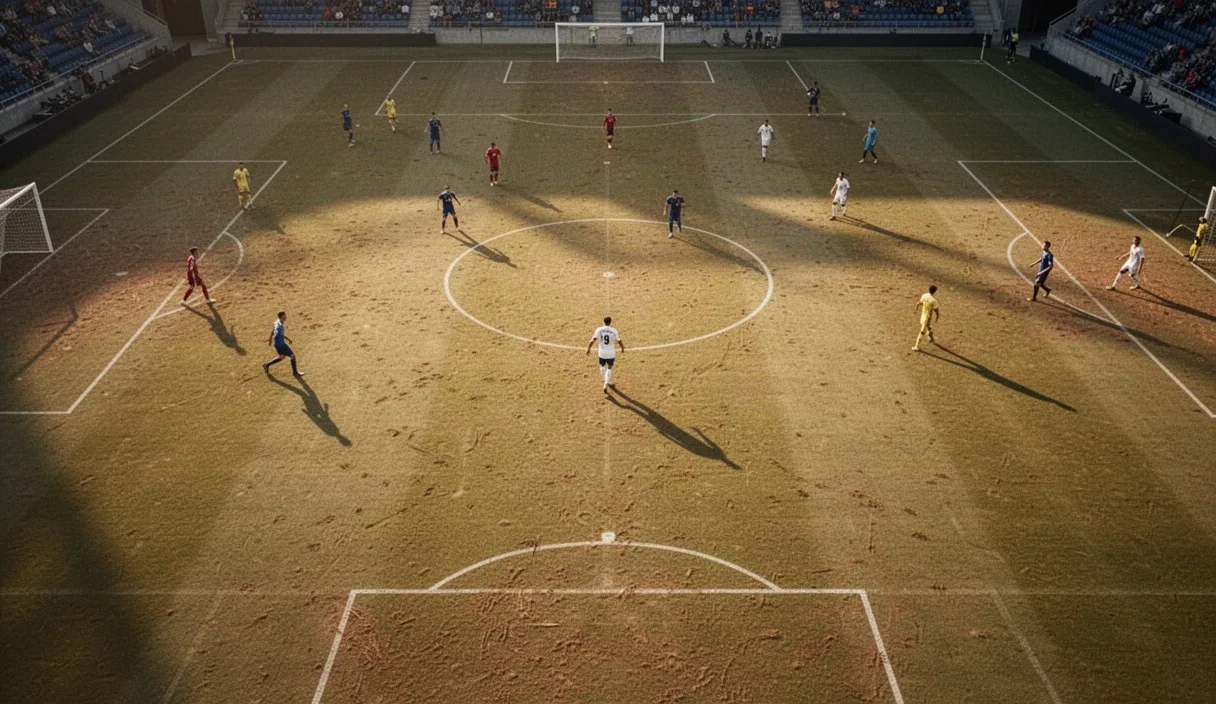
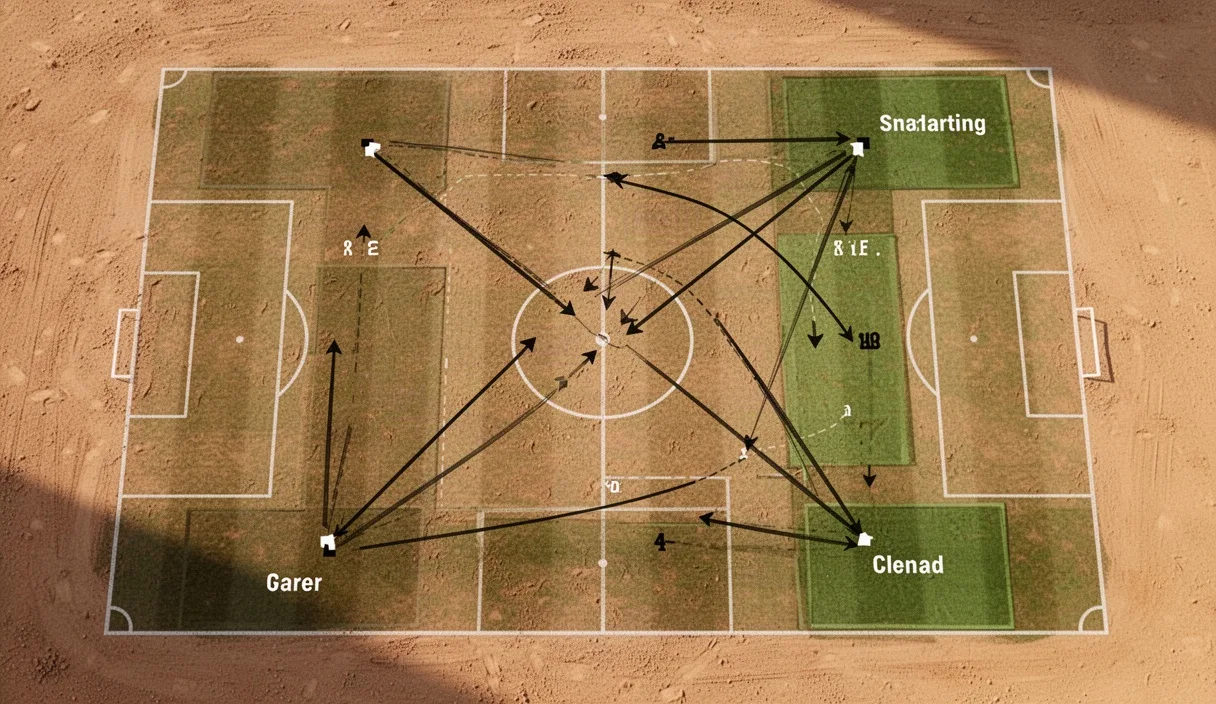

Watch two teams line up before kickoff and you'll see numbers next to player names: 4-3-3, 4-2-3-1, maybe a back three. It looks like a seating chart. But formations are not really about where eleven dots sit on a whiteboard. They are about who covers which patch of grass when the ball moves, and how quickly a team can turn defense into attack or vice versa. Two formations can share nine outfield players in nearly identical spots and still feel completely different to play against.
4-3-3 and 4-2-3-1 are the two most common shapes in modern football, and they get confused constantly because on a static graphic they can look almost the same: four defenders, a bank of midfielders, a front line, one out-and-out striker or three forwards spread wide. The real differences show up in movement, not in the starting picture. This article breaks down what changes when a team plays one over the other, why coaches pick each, and what to look for so you can tell them apart within the first ten minutes of a match.
Why formations are really about space, not shapes on paper
Think of a football pitch like a room with eleven people trying to control different areas of it at once. A formation is simply an agreement among teammates about who is responsible for which zone before the ball tells them otherwise. It is a starting arrangement, not a cage. Players are expected to drift, overlap, and swap zones constantly once play begins.
This is why two teams "in" 4-3-3 can look nothing alike. One might use it to flood the wings with numbers, the other to overload the middle of the pitch with quick combination passes. The formation number tells you the skeleton. It does not tell you the muscles and tendons, meaning the specific instructions about pressing triggers, passing lanes, and who tucks inside versus who stays wide.
A useful comparison: two restaurants can both have four tables near the window and six in the back, but one seats groups for quick turnover and the other for slow, long dinners. Same floor plan, completely different function. Formations work the same way. The number is furniture placement; the tactics are how the room actually gets used.
How 4-3-3 organizes attack and defense
In a 4-3-3, the front line is split into a central striker and two wide forwards who usually stay high and wide, stretching the opposing back four. Behind them, three central midfielders form a triangle, most often one holding player sitting slightly deeper with two more advanced midfielders ahead of him.
In attack, the width comes from the wingers rather than the fullbacks, which frees the fullbacks to push forward and support underneath or overlap outside them. This is why 4-3-3 teams often produce a lot of crosses and cutbacks from the byline, since both the winger and the overlapping fullback can occupy that space at different moments. Barcelona under Pep Guardiola and Liverpool under Jurgen Klopp are well-known examples, though they used the shape quite differently: Barcelona for possession-heavy build-up through the midfield triangle, Liverpool for rapid transitions where the wide forwards sprint into space behind a high defensive line.
Defensively, the front three usually start the press, with the two wide forwards curving inward to close passing lanes to the opposing center-backs while the central midfield trio screens the space in front of the back four. The weak point of a 4-3-3 tends to show up when the lone holding midfielder gets isolated: if the two more advanced midfielders get dragged forward or wide, that single pivot can be outnumbered two-against-one by opposing runners arriving late into central midfield.
How 4-2-3-1 organizes attack and defense
4-2-3-1 keeps a single central striker up top, but instead of two wide forwards flanking him, there is a band of three attacking players just behind: a central attacking midfielder and two players wide who can be either winger-types staying high or more inverted players cutting inside. Behind that band sit two central midfielders working together rather than one alone.
This double pivot changes the attacking build-up noticeably. With two players sharing the deep midfield job, one can step forward to join the attack or receive between the lines while the other stays back to cover. That flexibility is why 4-2-3-1 became the default shape for many international teams and mid-table club sides throughout the 2000s and 2010s: it offers protection without demanding elite individual discipline from a single midfielder, since responsibility is split two ways.
Going forward, the number 10 in behind the striker is the focal creative point, often the most technically gifted player on the roster, tasked with finding pockets of space between opposing midfield and defensive lines. Real Madrid used this shape for long stretches with Mesut Ozil or later Isco playing that number 10 role behind a central striker, feeding wide players and late runners. Defensively, the double pivot gives a team an extra layer of central protection, which is a major reason underdog teams in European competitions often set up in 4-2-3-1 against stronger possession-based opponents: it is harder to break through the middle when two midfielders are covering that lane rather than one.
The key difference: double pivot vs single holding midfielder
If there is one structural detail that separates these two formations more than any other, it is this: 4-3-3 typically relies on one deep midfielder to screen the center of the pitch, while 4-2-3-1 uses two. Everything else, wide forwards versus attacking band, striker positioning, fullback overlaps, tends to flow from that single structural choice.
A single pivot player, sometimes called a "number 6," has to read the game constantly: when to step up and press, when to drop and cover, when to shift sideways to help a fullback. Players like Sergio Busquets or Casemiro built entire careers mastering that one role because teams built their whole defensive shape around trusting one player to get those decisions right, over and over, for ninety minutes.
A double pivot spreads that responsibility. Two midfielders can specialize: one leans toward defensive covering, the other toward progressing the ball forward. This is easier to coach at levels where you don't have a generational reader of the game in your squad, which is one reason 4-2-3-1 is common in youth academies and mid-tier professional leagues. The tradeoff is that with two midfielders occupying central space, there is often less natural width and fewer bodies pushing high up the pitch compared to a 4-3-3's front three.
| Feature | 4-3-3 | 4-2-3-1 |
|---|---|---|
| Central midfield cover | One holding player | Two players sharing the role |
| Width source | Wide forwards | Wide players in the attacking band, often narrower |
| Creative focal point | Spread across midfield trio and wingers | Central attacking midfielder (the "10") |
| Common weakness | Lone pivot outnumbered centrally | Less natural width, fullbacks must provide more |
What kind of squad suits each formation
4-3-3 rewards teams with genuinely fast, one-on-one capable wide forwards, because so much of the attacking output depends on those players beating a fullback or cutting inside from the flank. It also needs a holding midfielder who is comfortable making rapid defensive decisions alone, since there is no second pivot player to lean on. Fullbacks in this system need real stamina, since they are expected to bomb forward constantly to provide width underneath the wingers.
4-2-3-1 suits squads with a standout creative player who thrives between the lines but might not have the explosive pace of a traditional winger. It is also a forgiving structure for teams without a dominant single defensive midfielder, since the double pivot shares that burden. A team with a technically strong, unselfish striker who can hold the ball up and bring the number 10 into play often gets more out of 4-2-3-1 than a formation demanding two wide sprinters.
Squad depth matters too. 4-3-3 tends to ask more of individual wide players physically over ninety minutes, so squads without strong rotation options at winger may see performance drop in the second half. 4-2-3-1, with its extra central body, is generally easier to hold defensively for longer stretches, which is why it often appears as a "safer" choice against stronger opposition or in the second leg of a tie when protecting a result matters.
How to tell them apart while watching
The fastest visual clue is what happens when the opposing goalkeeper has the ball. In 4-3-3, you will usually see two players stretched high and wide near the touchlines, almost level with the last defender. In 4-2-3-1, the wide players in the attacking band often sit slightly deeper and narrower, closer to the edge of the penalty area rather than hugging the touchline.
Another clue: count how many players drop to help build play from the back. If you consistently see two central midfielders splitting to receive from the center-backs, forming a temporary back-three look, that is a strong signal of a double pivot and therefore 4-2-3-1. If only one midfielder drops while two others stay higher and more advanced, that points to 4-3-3's single pivot structure.
Watch the fullbacks during open play as well. In 4-3-3, fullbacks frequently overlap outside the winger, sprinting past them on the outside since the winger has already cut inside or stayed high. In 4-2-3-1, fullbacks more often provide the width themselves, because the wide attacking players are positioned narrower, closer to the striker and number 10.
Common mistakes
- Assuming the formation number describes fixed positions rather than a starting template that shifts once the ball moves.
- Judging the shape only from a lineup graphic instead of watching actual player movement during build-up and defensive phases.
- Treating every 4-3-3 or every 4-2-3-1 as tactically identical, when the same numbers can produce very different styles depending on pressing triggers and player instructions.
- Overlooking the double pivot detail, which is usually the single clearest way to separate these two formations at a glance.
Next steps for watching smarter
Next time you watch a match, pick one moment: the opposing goalkeeper receiving a back pass. Pause mentally and count how many midfielders drop to help. One dropping player usually signals 4-3-3's single pivot; two dropping players usually signals 4-2-3-1's double pivot. That one habit will let you identify the shape faster than reading any pre-match graphic.
From there, track the wide players for five minutes. Are they hugging the touchline high up the pitch, or sitting narrower and closer to the striker? Combine those two observations, midfield structure and wide player positioning, and you will correctly identify which formation is in use most of the time, even before commentators or graphics confirm it.