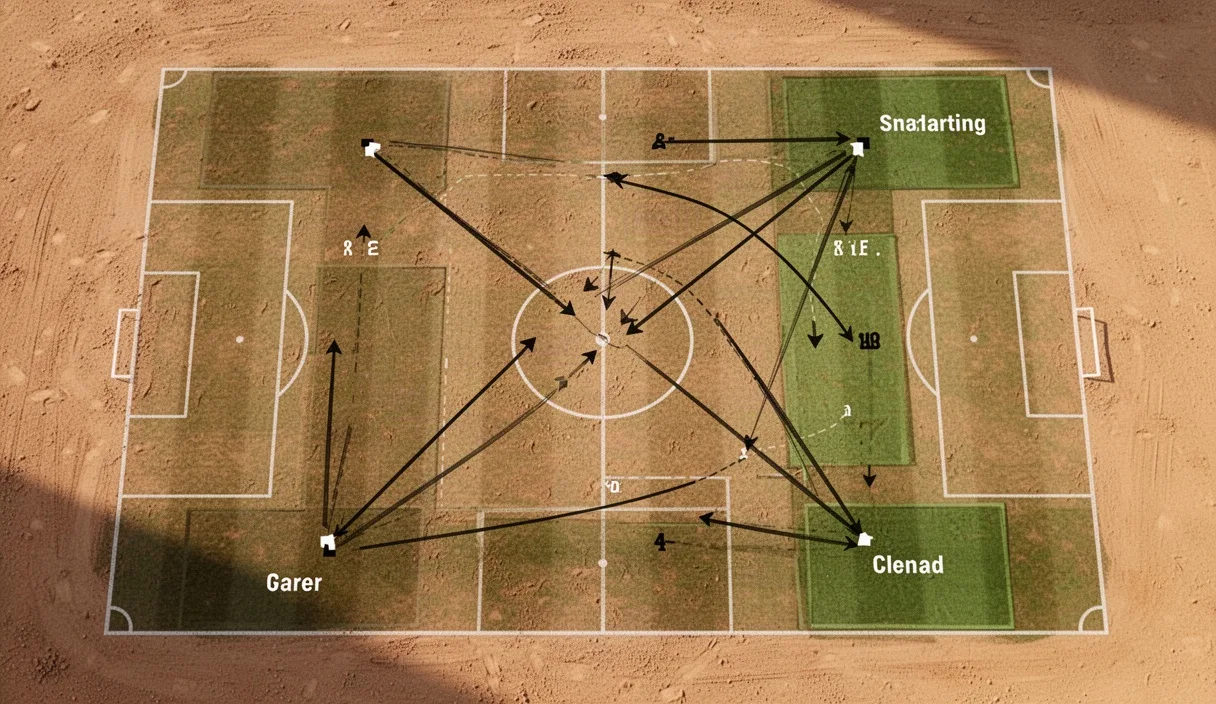
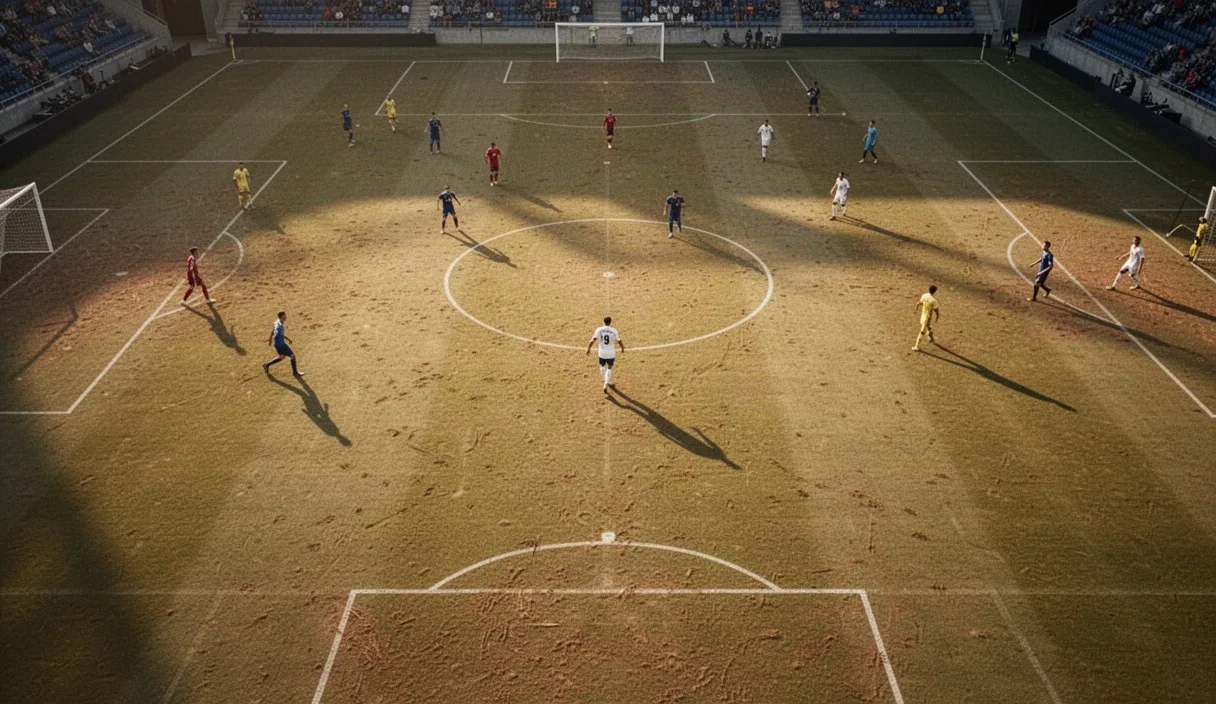

Picture a center back who spends every Saturday practicing how to defend against a big, strong striker. He knows the drill: stand between the striker and the goal, win the header, clear the danger. Then one day the number 9 he's marking drops twenty yards deeper, turns to face him, and starts playing like a midfielder. The defender freezes for a second, unsure whether to follow. That hesitation, multiplied across a back four, is the entire reason the false nine exists.
A false nine is not a trick or a gimmick. It's a practical answer to a specific defensive habit that almost every team relies on: marking players by position and by zone. When a team removes the one player defenders are trained to track closely, the whole defensive shape has to improvise. This article breaks down what the role actually is, why coaches use it, how it changes a defender's job in real time, and how you can spot it happening the next time you watch a match.
What "false nine" actually means
In football, the number 9 traditionally refers to the central striker, the player who stays highest up the pitch and looks to score. A "false nine" is a player who wears that attacking role on the team sheet but doesn't behave like a normal striker. Instead of staying high and central, they drop into midfield, drift wide, or roam between the lines, the space between a team's midfield and defense.
Think of it like a store that advertises a cashier at the front desk, but the person actually spends most of the day walking the aisles, restocking shelves, and chatting with customers. Anyone looking for "the cashier" in the expected spot won't find them there, because the job has changed even though the title hasn't.
The term became widely used in the late 2000s, especially once Lionel Messi played the position for Barcelona under Pep Guardiola in the 2008-09 and 2009-10 seasons. Messi was listed as the striker but frequently dropped ten to fifteen yards deeper than a typical number 9, forcing defenders to decide whether to chase him or hold their line.
It's worth noting a false nine is different from a "second striker" or an "attacking midfielder." Those roles are built into the formation from the start. A false nine specifically creates confusion because the team lines up looking like it has a normal striker, then breaks that expectation once the game starts.
The problem this role is trying to solve
Modern defenses are organized around marking zones and matching up against specific opposition roles. A center back's main job against a traditional striker is straightforward: stay tight, win physical duels, and don't let the striker turn and run at goal. This works well because center backs train specifically for that job, week after week.
The false nine attacks the assumption behind that training. If the striker constantly leaves the space a center back is supposed to guard, the center back faces an uncomfortable choice:
- Follow the striker deeper: this wins the individual battle but drags a defender out of position, often opening a gap for a winger or attacking midfielder to run into.
- Stay put: this keeps defensive shape but hands the striker free space to receive the ball, turn, and pick a pass.
Neither option is comfortable, and that discomfort is the entire point. Guardiola didn't play Messi as a false nine because it looked elegant, he did it because Barcelona's opponents kept sending a physical center back to mark a traditional striker, and removing that striker from the usual space made the center back's job pointless. A defender who has nobody to mark either has to abandon their position or stand still and watch the game happen elsewhere.
How a defender's job changes when facing one
Against a normal striker, a center back's decision-making is fairly simple: track the runs, win the headers, hold the offside line. Against a false nine, several other players get pulled into decisions that used to belong to just one position.
| Situation | Against a traditional striker | Against a false nine |
|---|---|---|
| Striker drops to midfield | Rarely happens; stay in the back line | Happens repeatedly; center back must choose to follow or release |
| Who marks the striker | Usually one center back, clearly assigned | Could be a center back, a defensive midfielder, or nobody, depending on the moment |
| Space behind the defense | Protected by staying compact | Often opened up because wingers or attacking midfielders run into the space the striker vacated |
This is why coaches sometimes assign a defensive midfielder, rather than a center back, to track a false nine. A center back who steps out of the back line leaves a hole that's hard to cover, but a midfielder moving forward a few yards to close down the same player doesn't break the defensive line in the same way. Diego Simeone's Atletico Madrid used exactly this idea against Roma's false nine setups, asking a midfielder to shadow the dropping forward instead of pulling a center back out.
The knock-on effect matters just as much as the direct one. Once a center back decides to follow the false nine into midfield, the two remaining defenders often have to shift across to cover the space, which can leave a full back isolated one-on-one against a winger. A single positional decision in the eighteenth minute can lead directly to a cross being whipped in during the sixty-third.
Famous examples and why they worked
Messi's spell as Barcelona's false nine is the reference point most people know, but understanding why it worked requires looking past the highlight reels. Messi wasn't just good on the ball, he specifically exploited the habit of center backs following strikers. When he dropped deep, Barcelona's actual center backs, like Carles Puyol at the time, weren't the ones facing him, so opposition center backs had to decide whether to abandon their line and chase a player who was faster and better on the ball in tight spaces. Most chose not to chase, and Messi picked passes from space that a normal striker would never have access to.
Francesco Totti at Roma under Luciano Spalletti, around 2006, is often cited as an earlier version of the same idea. Totti dropped from the front line to link play, and Roma's front three rotated positions constantly, which made it hard for a back four built around man-marking a central striker to hold their shape.
Roberto Firmino at Liverpool under Jurgen Klopp offers a different flavor of the same solution. Firmino wasn't primarily a creative passer like Messi, his value was in pressing. By dropping into midfield when Liverpool didn't have the ball, he could help win it back higher up the pitch, then Liverpool's actual runners, Sadio Mane and Mohamed Salah, would sprint into the space he'd just vacated. The false nine here solved a pressing problem as much as an attacking one.
What connects all three examples is timing. Each player didn't drop constantly, they picked moments when the opposition's shape was set for a normal striker, then moved. A false nine who drops on every single possession becomes predictable and easy to mark; the unpredictability is what causes the defensive hesitation.
When a false nine fails
The role depends on a specific weakness existing in the opponent: defenders who are rigidly trained to mark the striker's usual zone rather than react to what's actually happening on the pitch. Against a team that defends with a flexible, zonal approach, the false nine's main advantage shrinks considerably.
There's also a personnel cost. Removing a traditional striker from the box means fewer players are around to finish crosses, cutbacks, or rebounds. If the false nine's supporting cast, wingers, attacking midfielders, doesn't consistently make the late runs into the space that's been created, a team can dominate possession and territory while generating very few actual shots on target.
Physical directness is another weak spot. A false nine setup can struggle against a deep, compact defense that simply refuses to be pulled out of shape, because there's no strong central presence to hold the ball up against physical center backs or win second balls from long passes. Teams without a genuine aerial threat can find themselves starved of a "release valve" when their build-up play is pressed and they need a simple, direct option.
Spain's national team around 2012, sometimes using Cesc Fabregas as a false nine, is a commonly discussed example of diminishing returns. It worked well early on because opponents hadn't adjusted, but as more teams packed their defense and refused to chase Fabregas out of position, Spain's attack sometimes became sterile: lots of passing, very little penetration.
How to spot one while watching a live match
You don't need advanced tactical training to notice a false nine, you just need to watch one specific area of the pitch for a few minutes. Here's a simple checklist:
- Check where the number 9 actually stands during the opening minutes when the opposition has the ball. A traditional striker stays high, close to the last defender. A false nine often drops ten to twenty yards deeper.
- Watch the opposition center backs' body language. If one of them keeps glancing over their shoulder or jogging forward uncertainly, that's a sign they're debating whether to follow the striker.
- Look for late runners. If wingers or attacking midfielders are sprinting into the box just as the striker drops away from it, that space swap is a strong indicator the team is using a false nine deliberately.
- Notice if a defensive midfielder, rather than a center back, is the one closing down the striker. That's often a coach's specific instruction to avoid dragging the back line out of shape.
Commentators sometimes flag this instantly, but even without commentary, the pattern is visible once you know what to watch for: a striker who isn't where a striker should be, and defenders who look briefly unsure what to do about it.
Common mistakes
People new to tactical analysis often assume a false nine simply means "a small, technical player instead of a big one." Size has nothing to do with it, the definition is about movement and role, not physical build; a tall striker can drop and play as a false nine too.
Another common mistake is thinking the false nine role is fixed for all 90 minutes. In practice, most players who fill this role move fluidly between dropping deep and pushing high depending on the phase of play, and treating it as a constant rather than a situational tactic misses why it actually works.
Finally, viewers sometimes credit the false nine alone for chances created, without noticing the runners who exploit the space. The role is only half of a two-part mechanism, the space it creates is worthless if nobody sprints into it.
Watching for it next time
The easiest way to build this skill is to pick a match, mute the commentary for the first fifteen minutes, and simply track where the central striker goes every time the ball changes possession. Note down, mentally or on paper, how many times they touch the ball inside the box versus outside it. If most of their touches happen well outside the penalty area, you're likely watching a false nine setup.
From there, widen your focus to the two center backs marking that striker. Watching their footwork in the moments right after the striker drops tells you almost everything about whether the tactic is succeeding: hesitation and gaps mean it's working, calm zonal holding means the defense has done its homework.