
A goal gets scored, the stadium erupts, and then everyone sees the referee touch their earpiece. Thirty seconds later, half the crowd is confused about why the celebration stopped. What's actually happening in that pause is a structured, rule-bound conversation, not a group of people staring at replays until they feel like making a decision. Understanding the steps behind it makes the delay feel less like a mystery and more like a process with its own logic.
Think of VAR less like a referee's assistant and more like a second set of eyes checking a specific, narrow list of things, the way a proofreader checks for spelling errors but doesn't rewrite your essay. That comparison matters because most complaints about VAR come from expecting it to do a job it was never designed to do: catch every wrong decision. It was built to catch a much smaller category of mistakes, and knowing that category changes how you watch the review unfold.
What VAR is actually allowed to review
VAR does not review everything. It is limited, by law, to four categories of decisions: goals and whether anything in the buildup should have prevented them, penalty decisions, direct red card incidents, and cases of mistaken identity, such as cautioning the wrong player. Everything else, including most fouls, corners, throw-ins, and yellow cards, stays entirely with the on-field referee, no matter how wrong the crowd thinks the call was.
This is why a blatantly missed foul in midfield, one that leads to nothing, never gets reviewed, even if it's replayed twenty times on broadcast. If that same foul happens two passes before a goal, though, it suddenly becomes reviewable, because it falls under "attacking phase of play leading to a goal." The trigger isn't how bad the missed call looks, it's whether it fits one of the four boxes.
A simple way to picture it: VAR is like a smoke detector wired only to the kitchen and the garage. A fire in the living room won't set it off, even if it's serious, because that's not where the sensor is pointed. Fans often assume the sensor covers the whole house.
Who talks to whom during a check
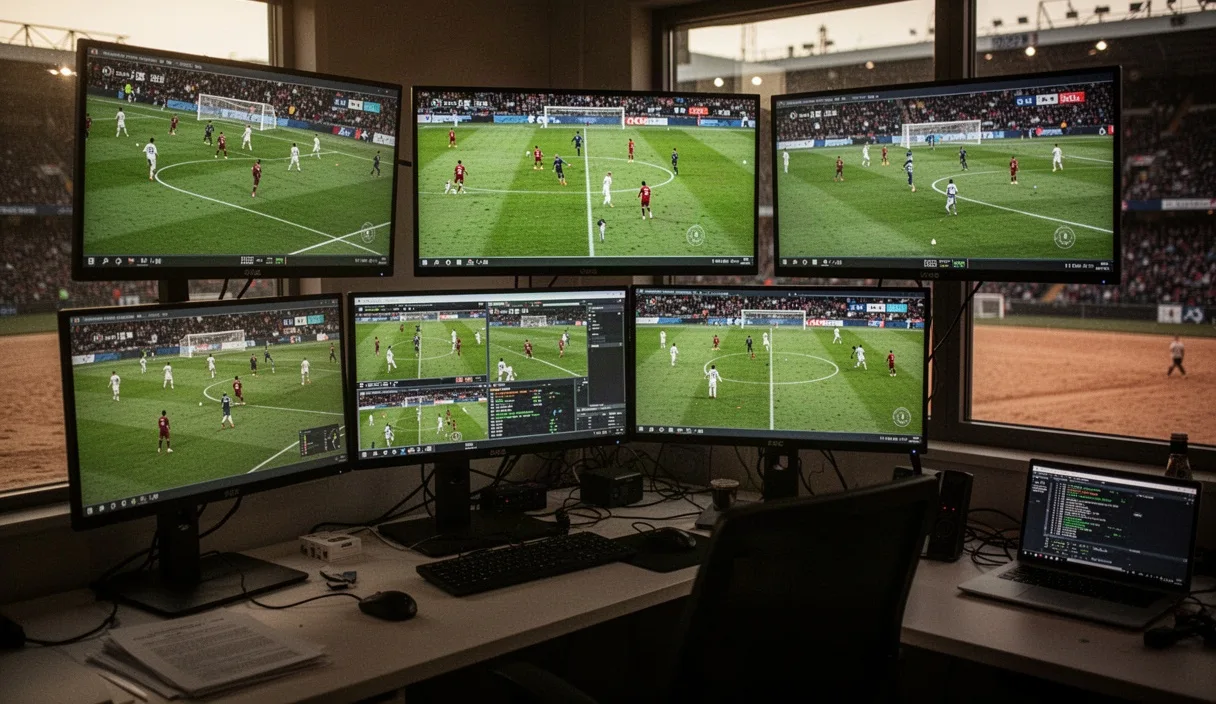
Every review runs through a specific chain of people, not just "the referee and a screen somewhere." The video assistant referee, usually sitting in a broadcast production truck away from the stadium, watches multiple camera angles simultaneously along with an assistant VAR and a replay operator who pulls specific clips on request. The on-field referee wears an earpiece connected directly to this room.
The conversation typically follows this order:
- The VAR spots a potential issue, or the referee radios in asking for a look at something.
- The VAR reviews the incident using several camera angles, including any specialist angles like the offside broadcast camera.
- The VAR tells the referee, "check complete, no issue" or "recommend you review" a specific incident.
- If a full review is needed, the referee is told to go to the pitchside monitor.
- The referee watches the replay independently and makes the final call.
That last step matters more than people realize: the VAR can recommend, but under most competition protocols the on-field referee retains authority to make the final decision after viewing it themselves, except in factual matters like offside lines, which are usually communicated directly since they involve measurement rather than judgment.
The difference between a 'check' and a full 'review'
Every single incident in the four reviewable categories gets a "check," and almost none of them require a "review." A check happens silently, in the background, without the game stopping or the crowd even noticing. The VAR team is quietly confirming there's no clear and obvious error, and if that's the case, play simply continues.
A full review is different: it's visible, it stops the game, and it usually involves the referee walking to the sideline monitor. This only happens when the VAR believes there's a clear and obvious error serious enough to overturn the on-field decision, or when a factual matter like a handball or offside needs closer inspection than the VAR alone can settle by talking the referee through it.
| Feature | Silent Check | Full Review |
|---|---|---|
| Visible to fans | No | Yes, referee goes to monitor |
| Frequency per match | Happens on nearly every reviewable incident | Rare, often zero to two per match |
| Who makes final call | VAR confirms no error, game continues | Referee decides after watching replay |
| Typical duration | Under 20 seconds | 60 to 180 seconds |
An example: on nearly every goal scored, the VAR is silently checking the buildup for offside or a foul. Fans never see this because nothing is found. It's only when something is flagged, like a striker's toe being fractionally ahead of the last defender, that the process becomes visible and turns into a review.
Why some reviews take longer than others
Not all reviews take the same amount of time, and the difference usually comes down to how much footage needs sorting through and how many camera angles exist for that particular incident. A clear handball on a wide open pitch, caught by three broadcast cameras from different angles, might take 40 seconds to confirm. A shove inside a crowded penalty box during a corner kick, partially blocked by other players, can take over two minutes because the VAR team has to cycle through six or seven angles looking for one that actually shows contact.
Offside reviews involving the semi-automated system, now used in many top competitions, tend to be faster once the calibrated skeletal tracking points are generated, since the system does the line-drawing rather than a human eye judging a broadcast freeze-frame. Without that technology, a tight offside call can take longer because the VAR has to find a frame where the ball leaves the passer's foot and then manually align a line across defenders' bodies, something that's easy to get roughly right and hard to get precisely right.
Weather and camera coverage also play a role. A match with limited broadcast cameras, common in lower divisions or smaller stadiums, gives the VAR fewer angles to work with, which can either speed things up because there's less to sift through, or slow things down because no angle clearly resolves the question.
What 'clear and obvious error' means in practice
This phrase is the entire philosophy behind VAR, and it's often misunderstood. It does not mean "an error." It means an error that is obvious even without slow-motion replay or frame-by-frame analysis, something that would look wrong to a reasonably attentive observer watching at normal speed. The standard exists specifically to stop VAR from becoming a tool that re-referees every fifty-fifty decision.
A practical comparison: imagine a teacher grading an exam and told to only correct answers that are unmistakably wrong, not answers where reasonable people might disagree. If a student writes "2+2=5," that's a clear and obvious error. If a student's essay argument is debatable but defensible, the teacher isn't supposed to intervene just because they'd have written it differently.
This is why contact in a penalty box that could reasonably be seen as either a foul or a fair challenge, depending on interpretation, usually stays with the referee's original call, even after VAR looks at it. The review isn't asking "what's the best decision," it's asking "was the original decision so wrong that no reasonable referee would have made it." That's a much higher bar, and it explains why some replays that look bad on social media clips still don't get overturned.
Why VAR still can't fix every controversial call
Even with cameras covering nearly every angle of the pitch, plenty of decisions remain matters of judgment rather than fact. Whether a challenge was reckless or just aggressive, whether a hand was in a "natural position" during a fall, whether a player deliberately handled the ball or it struck an arm accidentally, these are interpretive calls, and VAR was never built to replace human judgment on them, only to catch outright factual mistakes.
There's also the limitation of camera coverage itself. Broadcast cameras are positioned for storytelling and viewing experience, not for officiating precision, so certain incidents, particularly ones that happen behind a cluster of players or just outside a camera's field of view, simply can't be resolved definitively no matter how many replays are checked.
Finally, the clear and obvious error standard is intentionally conservative by design. It exists to prevent constant stoppages and to preserve the referee's authority as the primary decision-maker on the pitch. That tradeoff means some incorrect calls that are close, but not blatant, will stand, and that's not VAR malfunctioning, that's VAR operating exactly as it was built to.
Common mistakes fans make when judging a VAR decision
Assuming any missed call is a "VAR failure" is probably the most frequent mistake, when in reality most missed calls fall outside VAR's four reviewable categories entirely. Another common one is judging offside lines by eye from a broadcast angle, without accounting for camera distortion, which is exactly why the semi-automated system with tracked calibration points was introduced in the first place. People also tend to confuse a check with a review, assuming nothing happened just because the referee didn't visibly go to the monitor, when in fact a silent check was completed and cleared within seconds.
Where to go from here if you want to understand VAR decisions better
Watching a broadcast's on-screen graphic explaining the review, when available, is a good habit, since most major competitions now show which of the four categories triggered the check. Reading the official Laws of the Game section on VAR, published by IFAB, is worth doing once if you want the precise wording behind "clear and obvious," rather than relying on commentary paraphrasing. And if a specific decision in a match you care about seems genuinely inconsistent with how similar plays were handled elsewhere, following up with the competition's official statement after the match, many leagues now release brief explanations for high-profile reviews, will usually clarify the reasoning far better than replay debates in the moment.