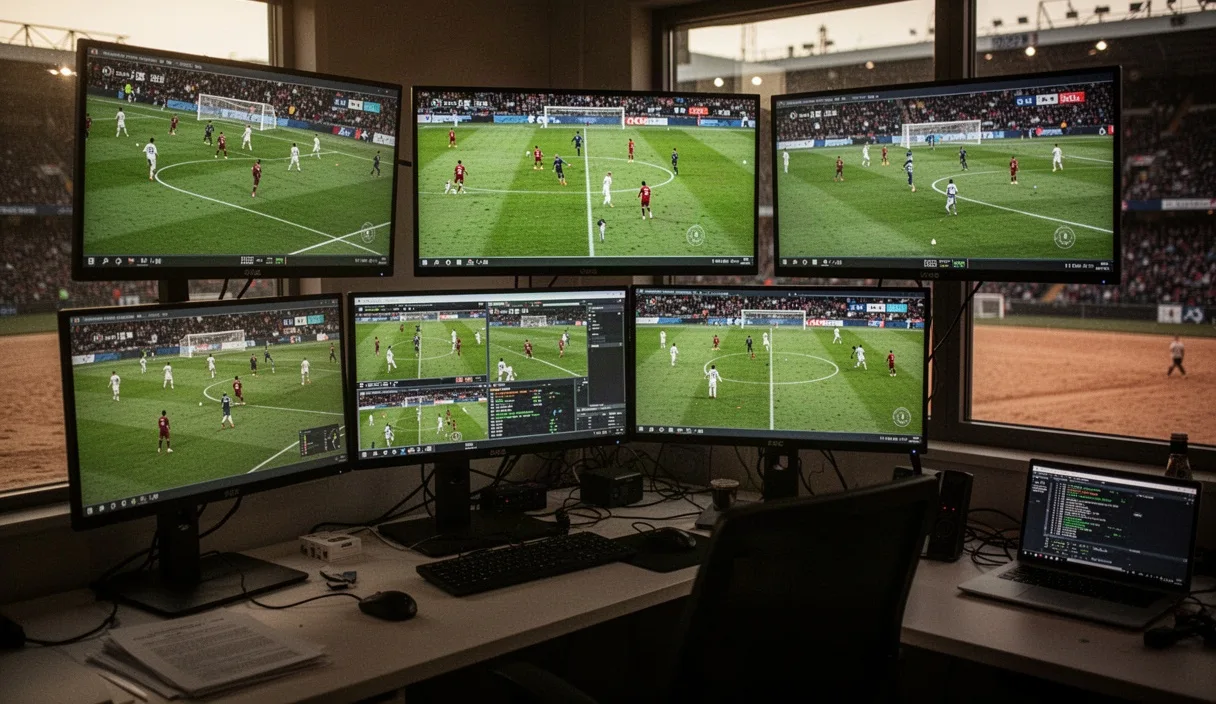

Watch any football match for ninety minutes and you will almost certainly hear a groan go up somewhere in the stadium over an offside call. It is the rule that fans argue about in pubs, that pundits freeze-frame on television, and that referees' assistants have to judge in a fraction of a second while running at full speed. Yet underneath all the controversy, the offside rule is built on one simple idea: a player should not gain an advantage by starting their run ahead of the last defender and the ball.
This article breaks down why the offside line moves the way it does, what actually counts as interference, and why the same pass can be legal in one moment and illegal a second later. We will use a plain comparison from everyday life to make the timing clear, then look at how technology has changed the way these tight calls get made.
The one moment that decides an offside call
Offside is not judged on where a player ends up. It is judged on one exact moment: the instant the ball is played by a teammate. Everything else, where the attacker runs to afterward, whether they score, whether they look offside on a replay taken a second later, is irrelevant to the original decision.
At that single moment, the assistant referee (or the VAR operator) checks two things. First, is the attacking player in the opposing team's half of the pitch? Second, are they ahead of both the ball and the second-last opponent, which is usually the last outfield defender since the goalkeeper is normally the last man? If both are true, the player is in an offside position.
Here is why the timing matters so much: a striker can be standing three metres behind the last defender when their teammate starts the pass, then sprint past that defender a full second later to meet the ball. That is perfectly legal, because the offside position is locked in at the moment of the pass, not at the moment of the touch or the shot. Reverse the order, if the striker is ahead of the defender at the moment the ball is kicked, it does not matter if they later drift back level with the defender before receiving it. The position at the moment of the pass is what counts.
A simple everyday comparison: jumping the start of a race
Think about a school sprint race with a starting gun. The rule is not that runners must stay behind a certain point during the whole race, it is that they must not leave the blocks before the gun fires. Once the gun goes off, they can run anywhere on the track. Offside works the same way, except the "gun" is the moment the ball leaves the passer's foot.
If a runner's foot is even a centimetre over the start line when the gun fires, that is a false start, no matter how far behind everyone else they were a second earlier or how far ahead they finish. Offside is judged the same way: a toe, a shoulder, or a knee that is even slightly ahead of the last defender at the moment of the pass is enough for an offside position, even if the rest of the player's body is level or behind.
This comparison also explains why fans sometimes feel a call is "unfair" when a player is offside by what looks like inches. In a 100-metre race, nobody complains that a runner who left the blocks one hundredth of a second early gets disqualified, because the rule is about timing, not about how big the advantage looks. Football applies the same logic: the margin does not need to be large to count, it only needs to exist at the right moment.
What counts as "interfering with play"
Being in an offside position is not automatically an offside offense. A player can stand in an offside position all game and never be penalized if they never touch the ball or affect the play. The offense only happens when that player does one of three things while in an offside position:
- Plays or touches the ball passed or touched by a teammate.
- Interferes with an opponent, for example by blocking their line of vision, contesting for the ball, or making a challenge.
- Gains an advantage from being in that position, such as the ball rebounding to them off a goalpost, the goalkeeper, or another defender after they were in an offside spot when the original shot was taken.
A common example: two attackers run forward on a through ball. One is in an offside position, the other is level with the defender and therefore not offside. If the ball goes to the player who is not offside, no offense has occurred, even though their teammate was standing offside just a few metres away. The offside player only becomes relevant if the officials decide their presence affected the defender's ability to deal with the ball, for example by distracting them or blocking a tackle.
This is the part of the rule that causes the most confusion, because "interfering with an opponent" involves judgment. A player standing offside in an empty part of the pitch, ten metres from the ball, is almost never penalized. A player standing offside directly in a goalkeeper's eyeline as a shot comes in almost always is. Referees are trained to ask whether the offside player realistically affected the defending side's ability to play the situation normally.
Why the rule only applies in the attacking half
Offside can only be called when the attacking player is in the opponent's half of the pitch. If a player is level with or behind the halfway line, no offside offense can be called at all, no matter how far ahead of the defenders they are standing. This is why a team pressing high can sometimes leave a huge gap in their own half without conceding an offside-related problem, the rule simply does not apply back there.
The reasoning is practical rather than mysterious: offside exists to stop players camping directly in front of the goalkeeper waiting for a long ball, sometimes called "goal-hanging" in older commentary. That danger only exists near the opponent's goal. A player standing in their own half cannot meaningfully "hang" near a goal they are attacking from ninety metres away, so the rule does not need to apply there.
This half-of-the-pitch condition also explains a tactic used by many modern teams: pushing the defensive line up near the halfway line to compress the space in which forwards can be played offside. If the last defender stands on the halfway line itself, any attacking teammate ahead of them and ahead of the ball, while also in the opposing half, is in an offside position. Move that defensive line ten metres higher, and the space where an attacker can safely receive the ball ahead of them shrinks by the same distance.
Common misunderstandings fans have
Several offside myths persist even among people who watch football regularly. Clearing them up removes a lot of the confusion around contested goals.
| Misunderstanding | What actually happens |
|---|---|
| "You can't be offside from a throw-in." | True, this one is correct. Offside does not apply directly from a throw-in, corner kick, or goal kick. |
| "The goalkeeper always counts as the last defender." | Not necessarily. If the goalkeeper is out of position, for example caught upfield, the second-last opponent could be an outfield defender instead. |
| "Being offside by a fraction is still a fair goal if it doesn't look like an advantage." | The rule does not weigh how big the advantage was, only whether the position existed at the moment of the pass. |
| "A player is offside if they're ahead of the ball anywhere on the pitch." | Only applies in the opponent's half, and only relative to the second-last opponent, not just the ball alone. |
Another frequent point of confusion is passes that go backward. A player cannot be offside from a pass played backward to them by a teammate who is further forward, because at the moment of that pass the receiving player is behind the ball, not ahead of it. This is why teams often work the ball backward to an unmarked midfielder rather than risk a forward pass being flagged.
How VAR checks offside differently from a linesman's eye
A human assistant referee has to judge offside in real time, standing on the touchline, tracking both the moment the ball is struck and the position of the last defender, often from an angle that is far from perfect. Studies of professional leagues have found that assistant referees get the vast majority of offside calls right, but tight margins of a few centimetres are extremely difficult to judge by eye alone, especially at full sprint speed.
Video assistant referee (VAR) systems used in top competitions work differently. Cameras capture the exact frame at which the ball is played, and lines are drawn using calibrated pitch markings to check the position of the attacker's furthest-forward body part against the defender's furthest-back body part at that exact frame. Some competitions use semi-automated systems with sensors in the ball and multiple tracking cameras to generate this line automatically rather than by a human drawing it manually.
The key difference is not the rule itself, VAR applies the same law as a linesman, it is the precision of the moment being checked. A human eye glancing sideways during a fast-moving phase of play might misjudge a gap of ten or fifteen centimetres. A calibrated camera frame can measure that same gap far more reliably, which is why goals that once stood for decades under human officiating are sometimes overturned on review today.
It is worth noting that VAR reviews still involve human judgment for the "interfering with play" questions, blocking a goalkeeper's view or contesting the ball is not something a line on a screen can measure. So even with technology, offside remains part measurement and part interpretation, which is exactly why disagreements about it are unlikely to disappear completely.
Putting it into practice: what to watch for next time
Next time a close offside call happens during a match, try tracking three things in order: where the ball is at the exact moment it is passed, where the attacker's body is relative to the last defender at that same moment, and what the attacker actually does once the ball arrives. Doing this in that order mirrors exactly how officials are trained to assess the situation, and it usually explains a decision that looked confusing on first viewing.
If you referee youth or amateur matches yourself, it helps to physically freeze your focus on the passer's foot rather than watching the attacker run, since human eyes struggle to judge two moving points at once. Many grassroots referee courses recommend this technique, and it is worth practicing with a coach or experienced official before officiating a competitive game, since offside judgment genuinely improves with repetition rather than instinct alone.