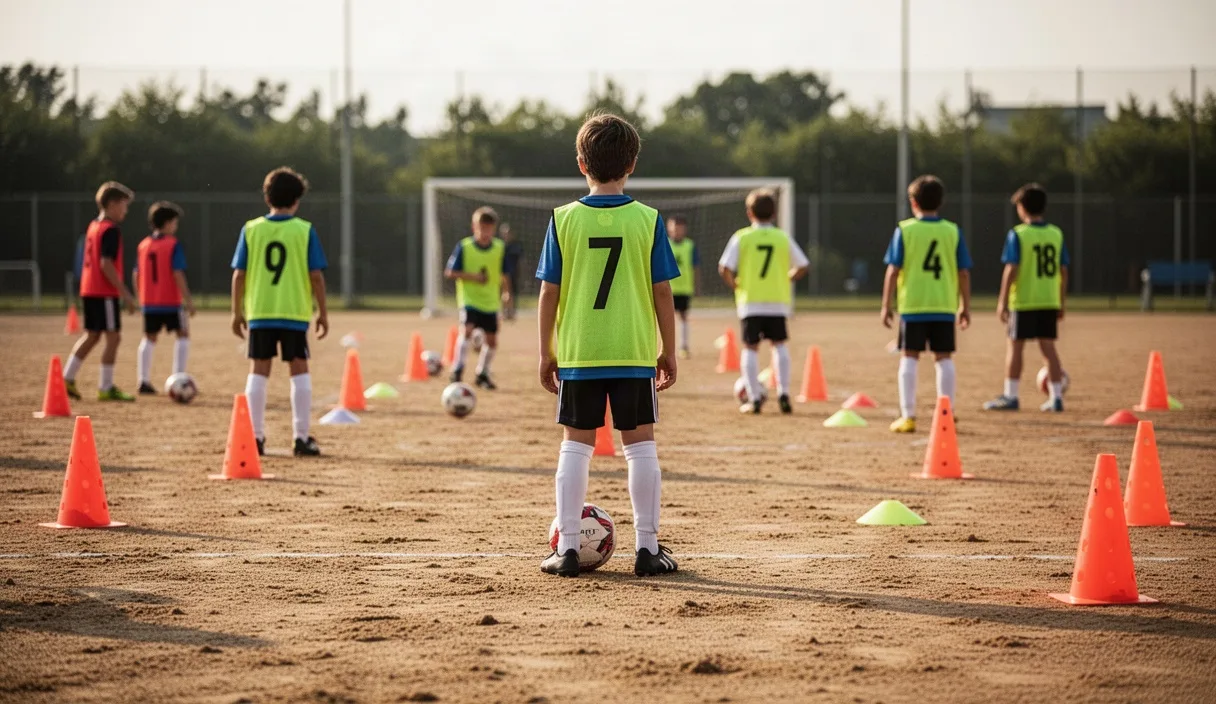

Walk past a football academy session for eight-year-olds and you might feel a little confused. There's no full pitch, no eleven-a-side match, and often no goalkeepers standing between two tall posts. Instead you see clusters of four or five kids chasing a ball inside a space the size of a tennis court. Parents sometimes ask the obvious question: is this actually football training, or just supervised playtime?
The honest answer is that it's both, and that's the point. A football academy for children under 12 isn't trying to build a smaller version of a professional team. It's trying to build the raw materials, quick decisions, comfortable touches, and confidence under pressure, that a bigger tactical picture will need later. Think of it the way a carpentry apprentice learns to hold a chisel and read the grain of wood long before anyone lets them build a cabinet. The tools come first. The finished product comes much later.
Why early academy training doesn't look like a match
A full-size match asks a nine-year-old to do something their brain and body aren't ready for yet: track 21 other moving objects, remember a position, and execute a role within a system. Sports scientists who study youth development often point to a simple limitation, working memory and peripheral awareness in children under 12 are still developing, so flooding them with information doesn't build skill, it just builds confusion.
Academies address this by shrinking the problem. A typical session for a seven- or eight-year-old might include:
- Ball-mastery drills, using only the feet and a single ball for 10 to 15 minutes
- Small grid games (3v3 or 4v4) with no fixed positions
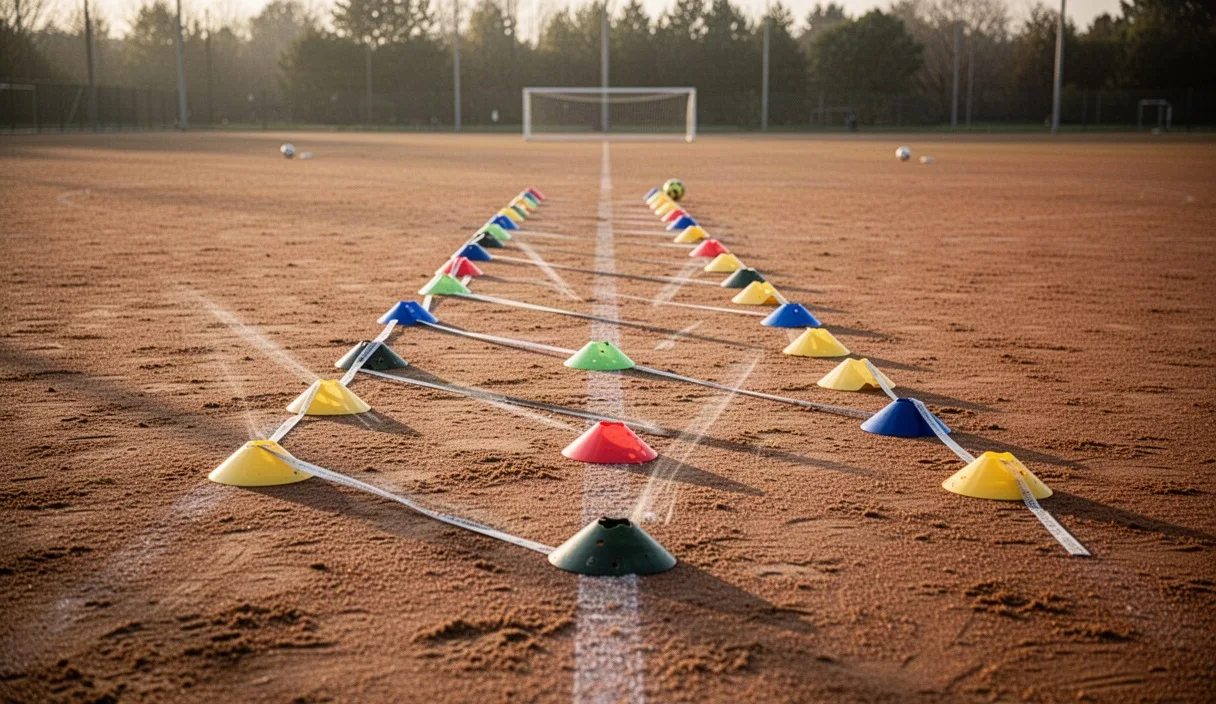
- Simple decision drills, such as "if a coach shouts a color, dribble toward that cone"
- A short scrimmage at the end, mostly for enjoyment rather than tactical teaching
Compare this to teaching someone to cook. You wouldn't hand a ten-year-old a full holiday dinner to prepare on day one. You'd have them practice cracking eggs, chopping vegetables, and reading a recipe. The dinner comes once those smaller skills are automatic. Youth football training works the same way: technique before tactics, because tactics without technique is just standing in the right spot with no ability to do anything once the ball arrives.
The reasoning behind small-sided games
Small-sided games, matches with four, five, or seven players per side instead of eleven, aren't a simplified version of "real" football. They're a deliberate teaching tool, and the reasoning is mostly about touches and repetition.
In an eleven-a-side match with young children, a single player might touch the ball 15 to 20 times in an entire 40-minute game. Much of that game is spent standing, jogging, or watching play happen far away. In a 4v4 game on a small pitch, the same child might get 60 to 80 touches in the same amount of time, because the ball is never far from anyone and there's nowhere to hide.
Here's a simple side-by-side to show why coaches favor the smaller format for young age groups:
| Factor | 11v11 match | 4v4 small-sided game |
|---|---|---|
| Average touches per player (40 min) | 15-20 | 60-80 |
| Space to hide from the ball | High | Very low |
| Decision-making moments per minute | Low | High |
| Need to understand tactics | High | Minimal |
More touches means more repetitions of the same basic problem: what do I do with the ball right now? That repetition is where comfort and confidence actually come from. Nobody gets good at dribbling by watching someone else dribble; they get good by doing it themselves, over and over, in low-stakes situations.
What coaches watch for in young players' decisions
Ask a youth coach what they're actually evaluating during a session, and most won't mention speed, strength, or even goals scored. At this age, coaches are mainly watching how a child solves small problems with the ball at their feet.
Some of the specific things a coach tracks during a simple 3v3 grid game include:
- Does the player look up before receiving the ball, or only after?
- When facing a defender, do they try to dribble past, pass, or freeze?
- Do they recover quickly after losing the ball, or sulk and disengage?
- Can they use both feet, even clumsily, or do they always shift to their stronger foot?
None of these are things a scoreboard can measure. A child might lose their small-sided game 5-2 and still be developing faster than a teammate who "won" but only ever passed sideways to avoid risk. This is one reason many academies don't publish standings or league tables for players under 10, results simply aren't the useful signal at this stage.
A good comparison here is learning to ride a bike on a quiet street before riding in traffic. The goal isn't to get somewhere fast. It's to fall off, wobble, correct, and eventually balance without thinking about it. Coaches are watching the wobbling and correcting, not the finish line.
Why formations are introduced later, not sooner
Formations, the 4-4-2 or 4-3-3 shapes people see in adult football, are essentially agreements about space: who covers which area of the pitch and when. Understanding that agreement requires a child to hold a mental map of the whole field while also controlling a ball at their feet. That's two demanding tasks running at once.
Most academies delay formal formation training until around age 11 or 12, sometimes later, for a practical reason: research and coaching experience both suggest that spatial-tactical understanding develops on a slower timeline than technical skill. A child can learn to strike a ball cleanly with practice well before they can reliably explain why a fullback should tuck inside when the ball is on the opposite side.
Introducing formations too early tends to produce a familiar problem coaches call "shape without substance." Children stand in the correct spots because they were told to, but they don't understand why, so the moment the game gets chaotic (which happens constantly at that age), the shape collapses because no one actually grasped the reasoning behind it. It's a bit like memorizing a phone number without understanding that the digits represent an actual line of communication to another person: it looks right until you need it to actually work.
The role of free play alongside structured sessions
Not everything useful happens inside a scheduled academy session. Many coaches and youth development researchers point to unstructured, unsupervised play, kids playing on their own in a backyard, park, or street, as a major contributor to creativity on the ball.
Structured training teaches technique inside controlled repetition: 20 minutes of cone dribbling, a passing drill in pairs, a shooting circuit. Free play offers something different: no coach telling them what to try next, no drill to follow, just a ball, some friends, and the freedom to attempt something ridiculous, like a trick move that fails nine times before it works once.
Some academies now actively encourage this by ending sessions with 10 to 15 minutes of pure open play with no instruction at all. A few even recommend that parents avoid additional lessons on weekends and instead let their child play informally with siblings or neighborhood kids. The reasoning is straightforward: a child who only ever touches a ball inside adult-supervised drills rarely develops the improvisation that shows up in tight game situations later.
What parents can reasonably expect to see improve
Parents often want a clear signal of progress, and it helps to know what actually shows up first. In the first year or two of structured training, most children improve noticeably in a specific, narrow set of areas rather than everything at once.
Reasonable things to expect within a season or two of consistent training (roughly one to two sessions per week):
- Better first touch, meaning the ball doesn't bounce three feet away every time they receive it
- Increased comfort using the weaker foot for simple passes, even if it stays less accurate
- Willingness to attempt a dribble past a defender instead of immediately passing out of fear
- Faster recovery after a mistake, rather than visible frustration lasting several minutes
What usually does not improve much yet: consistent tactical awareness, long-range passing accuracy, or physical output like sprint speed, since those depend heavily on growth and maturity as much as coaching. If a parent has specific concerns about physical development, growth pain, or persistent discomfort during training, that's a conversation for a pediatrician or sports physiotherapist rather than a coach.
Common mistakes
A few patterns show up repeatedly among well-meaning parents and even some coaches working with children under 12:
- Judging progress by match results instead of touches, decisions, and effort
- Pushing early specialization into a single position before the child has explored the whole game
- Adding extra private lessons focused on tactics before basic ball control is comfortable
- Criticizing a "mistake" that was actually a reasonable attempt at something difficult, like a first-time pass that just missed
Each of these tends to slow development rather than speed it up, because they shift a child's attention away from experimenting and toward avoiding blame.
Where to go from here
If you're choosing or evaluating an academy for a child under 12, ask to watch a full session rather than just a highlight reel or a match day. Notice whether children are getting frequent touches on the ball, whether coaches ask questions ("what did you see there?") instead of just issuing instructions, and whether mistakes are met with patience rather than correction mid-play.
At home, resist the urge to introduce formations, tactics talk, or professional match analysis before age 11 or so. Instead, leave a ball in the backyard, let siblings or friends play informally, and treat this stage as skill-building, not competition. The tactical understanding will arrive on its own timeline once the technical foundation is solid, much like a person can't read a map well until they've first learned to walk confidently on uneven ground.